
Observability Maturity Assessment
Federal Government, Regulatory Compliance Agency
Overview
A federal regulatory compliance agency engaged Codeview Digital to assess the maturity of their observability practices across their entire application portfolio. The agency enforced compliance across multiple regulated industries and needed assurance that their monitoring capabilities could support the availability and performance demands of mission-critical enforcement systems.
The Challenge
The agency's observability capabilities had been built reactively over a decade, with each application team adopting their own monitoring approach. This created critical blind spots and operational inefficiencies:
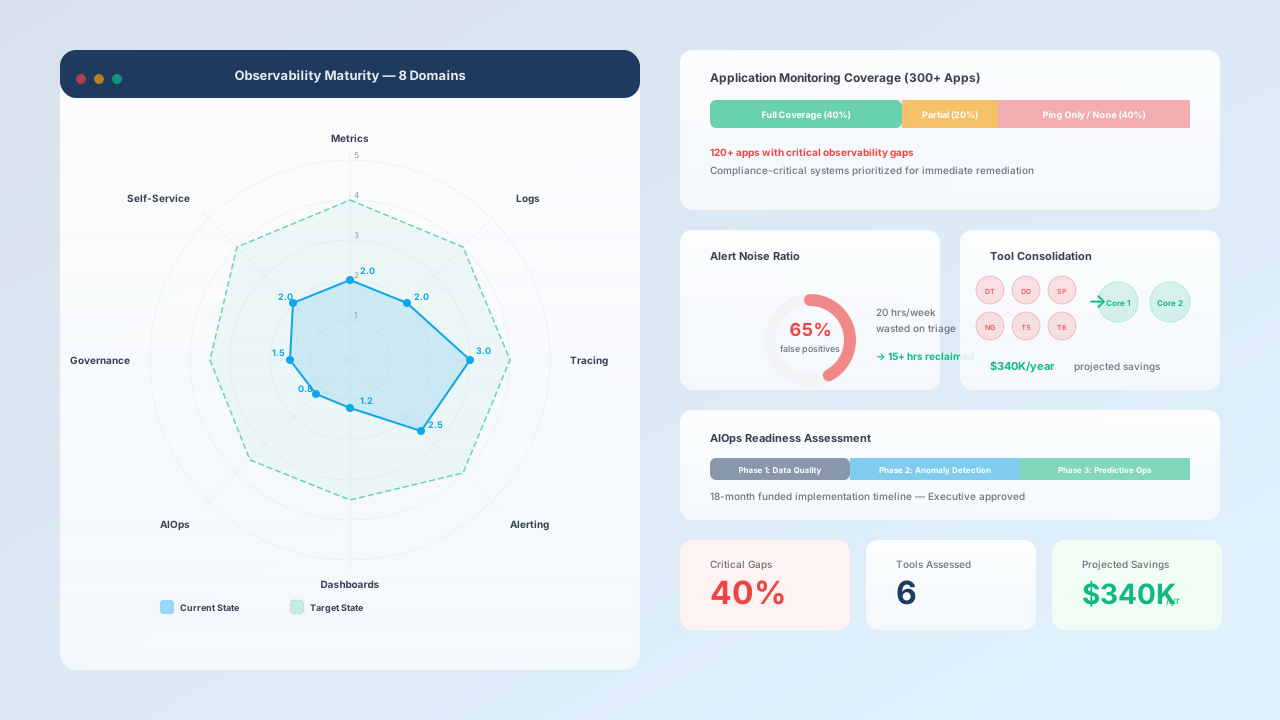
- 300+ applications with inconsistent monitoring coverage. 40% had no application-level observability beyond basic ping checks
- 6 different monitoring tools in use across teams with no integration or correlation capability
- Alert fatigue consuming an estimated 20 hours per week of senior engineering time triaging false positives and duplicate notifications
- No defined observability standards or baseline requirements for new application deployments
- Zero AIOps capability despite leadership mandate to adopt AI-driven operations within 18 months
- Inability to produce meaningful SLA compliance reports for regulated industry stakeholders
The Solution
Maturity Model Assessment
Applied a purpose-built observability maturity model across 8 capability domains (metrics collection, log management, distributed tracing, alerting, dashboarding, AIOps readiness, governance, and self-service), scoring each against federal and industry benchmarks.
Coverage Gap Analysis
Cataloged monitoring coverage across all 300+ applications, classifying each into coverage tiers and identifying the 40% with critical observability gaps requiring immediate remediation for compliance-critical systems.
Tool Rationalization Review
Evaluated all 6 monitoring platforms against a standardized capability matrix, recommending consolidation to 2 core platforms with clear migration priorities based on coverage gaps and license cost optimization.
Alert Quality Assessment
Analyzed 90 days of alert data to quantify noise ratios, identify duplicate alert sources, and design an alert optimization strategy projected to reduce false positives by 65% and reclaim 15+ engineering hours per week.
AIOps Readiness Scoring
Assessed the organization's data quality, integration maturity, and team readiness against AIOps prerequisites, delivering a phased enablement plan aligned with the 18-month leadership mandate.
Standards & Roadmap
Delivered observability baseline standards for all new application deployments and a prioritized 12-month improvement roadmap with quick wins, platform consolidation milestones, and AIOps enablement gates.
Tech Stack
Project Details
Timeline
6 weeks (October to November 2025)
Market Value
$95,000
Results
- Identified 40% of applications with critical observability gaps requiring immediate remediation
- Alert optimization strategy projected to reduce false positives by 65%
- Tool consolidation plan from 6 platforms to 2 with $340K/year in projected license savings
- Observability baseline standards adopted as mandatory for all new application deployments
- AIOps readiness plan approved by executive committee with funded 18-month implementation timeline
Related Services
Technology & Operations Assessments
In-depth assessments of your technology environment, processes, and capabilities. Know where you stand before you invest.
Learn moreObservability & AIOps Strategy
Modern monitoring strategy from a practicing AIOps product manager. Move beyond reactive alerting.
Learn moreReady to talk?
We don't do high-pressure sales. Just a straightforward conversation about your challenges and whether we can help.
Start a Conversation